
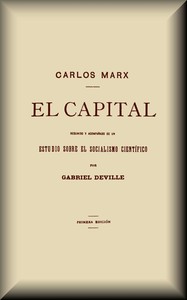
El capital: Resumido y acompañado de un estudio sobre el Socialismo científico
Let's be honest: most of us aren't going to read the 1,000+ pages of Karl Marx's Capital. It's dense, complex, and famously tough. That's where Gabriel Deville's book comes in. Written in the late 19th century by a contemporary socialist, this is a guide and summary meant to make Marx's big ideas accessible.
The Story
There isn't a plot in the traditional sense. Instead, the book walks you through the core arguments of Capital. It starts with a simple thing we all understand: a commodity, like a loaf of bread or a smartphone. Then, it asks how that thing gets its value. From there, it builds an explanation of capitalism, piece by piece. It talks about how profit is really generated from labor, the push for companies to grow endlessly, and the built-in tensions between the people who own the factories (capitalists) and the people who work in them (the proletariat). The second part of the book, the study on "Scientific Socialism," lays out the political and historical framework that springs from this economic analysis, arguing that social change is driven by these material conflicts.
Why You Should Read It
I picked this up out of historical curiosity, but I was shocked by how much it made me think about the modern world. Reading it, you'll start seeing "Marxist" concepts everywhere—in discussions about gig economy jobs, wealth inequality, or even why your favorite small shop got bought out by a big chain. It provides a vocabulary and a lens for understanding economic forces that often feel invisible. Deville isn't a neutral reporter; he's a believer. But that passion makes the summary engaging. You're getting Marx's ideas filtered through the enthusiasm of someone who saw them as a blueprint for the future.
Final Verdict
This is not a beach read. It's for the curious reader who has heard the terms "Marxism" or "capitalism" thrown around and wants to understand the source material without the Ph.D. workload. It's perfect for history buffs, politics nerds, or anyone who has ever felt frustrated by the economy and wants to know why it feels that way. You don't have to agree with it to get a lot out of it. Think of it as reading the most influential critique of our economic system ever written, in the clearest terms possible. It will challenge you, and that's the whole point.
There are no legal restrictions on this material. Preserving history for future generations.
Elizabeth Lopez
6 months agoThe layout of the digital version made it easy to start immediately, the evidence-based approach makes it a very credible source of information. Definitely a five-star contribution to the field.
Richard White
9 months agoHaving explored several resources on this, I find that the footnotes provide extra depth for those who want to dig deeper. It’s hard to find this much value in a single source these days.
Susan Davis
4 months agoThis digital copy caught my eye due to its reputation, it addresses the common misconceptions in a very professional manner. I'll be citing this in my upcoming project.
Noah Miller
11 months agoSimply put, the narrative structure is incredibly compelling. I will read more from this author.







Richard Harris
11 months agoMy first impression was quite positive because the logic behind each conclusion is easy to follow and verify. It’s hard to find this much value in a single source these days.