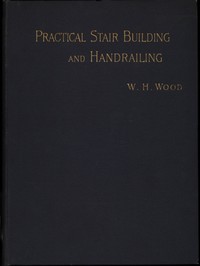
W. H. Wood opens his 1894 manual with a direct appeal to the reader who has stalled at an “unsatisfactory stage” in learning stair building. Rather than assume prior mastery, he dwells on elementary parts, warning that some details “should appear tedious” but are written for those who “seldom advance beyond a certain and very unsatisfactory stage.” The book is organized around 17 plates, each paired with descriptive text, and the author insists that Plates 12 and 13—covering solid geometry problems—must be “thoroughly understood” before tackling handrailing. Wood stakes his credibility on having “practically tested” every method, some “many times over,” and he presents his handrailing system as “somewhat new,” having been refined over five years of use.
The Falling Line as a Governing Principle
Throughout the excerpts, Wood returns to the falling line as the central geometric reference. In Plate 17, he instructs the reader to “draw the falling line resting on the corners as shown,” then uses it to develop tangents and determine the pitch of wreath sections. The falling line is not merely decorative; it dictates the alignment of balusters, the placement of risers, and the shape of the rail. Wood’s method requires the reader to project this line from plan to elevation, then use it to derive bevels and section lines. The emphasis on a single continuous line reveals a system designed to reduce cumulative error—a practical concern for a craftsman working in three dimensions.
Geometric Transfers from Plan to Mould
Wood’s instructions repeatedly move between plan, elevation, and face mould, demanding careful transfer of measurements. For example, in Plate 17 he writes: “Make A B, Fig. 3, equal A B, Fig. 4, draw section of rail at H as shown, draw S S parallel to A H.” The reader must carry distances from one diagram to another, often using compass arcs to intersect points. The process is exacting: “Make E D S equal E R C, Fig. 2, with D for centre, and R S, Fig. 2, as radius; strike an arc at C with S as a centre, and F C, Fig. 1, as radius.” Wood assumes the reader can visualize how a plan tangent becomes a horizontal trace in the mould, and how the semi-major axis is drawn “square to it through the centre.” These steps are not explained in general terms; they are executed stepwise, plate by plate.
Saw Cuts, Plank Orientation, and the Wreath’s Inside Face
Wood gives specific advice on the physical act of cutting a wreath from a plank. He recommends a “saw with a very thin blade, and set fine on the teeth and thin on its back edge” to keep it “working free.” The saw must be held “in the same direction as the section lines.” He distinguishes two methods: cutting the rail from the centre of the plank (Fig. 1) versus from the top (Fig. 2), noting that the latter gives “a much better appearance on the inside when finished.” However, this choice raises the level rail too high on the landing, so Wood shows how to adjust by bringing the “rising landing” out from the springing. These details reveal a craftsman’s attention to both structural accuracy and final visual quality, with the inside face of the wreath receiving particular care.
Wood’s manual is best read with a set of drawing tools at hand. The plates and text are tightly coupled; the reader should expect to move back and forth between them, tracing each construction. The author’s repeated insistence on understanding the “why and wherefore” of the geometry suggests that mere copying of steps will not suffice. For those willing to work through the problems in solid geometry, the book offers a coherent system that Wood himself used for years. The falling line method, once grasped, provides a repeatable framework for designing stairs and handrails of varying complexity.
The rain kept me indoors with that 1894 stair-building manual, its plates of wreaths and tangents oddly calming. There is something patient in geometric lines, a faith that order reveals itself. That quiet trust in unseen structure reminded me, somehow, of early flight, of Story of the Aeroplane — Context and Discussion, which treats another kind of rising, equally methodical, equally hopeful.