
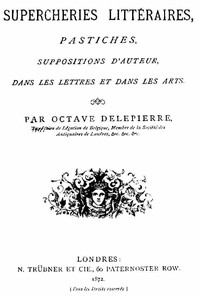
Supercheries littéraires : pastiches, suppositions d'auteurs dans les lettres…
First published in the 1800s, Octave Delepierre's Supercheries littéraires (Literary Hoaxes) isn't a novel with a plot in the traditional sense. Think of it more as a guided tour through history's greatest literary cons and confusions.
The Story
Delepierre acts as our guide, collecting case after case of literary trickery. He shows us forgeries of famous authors' works, like fake letters from historical figures or entire plays falsely credited to someone like Molière. He digs into pastiches—works written so perfectly in another author's style that they were mistaken for the real thing. He also explores false attributions, where a poem or text gets attached to the wrong name for generations, often by accident. The 'story' is the unraveling of each deception. Delepierre explains how the hoax was created, why people believed it, and finally, how the truth came to light. It's a series of 'aha!' moments, showing that the literary world has always had a shadowy side of imitators, pranksters, and outright frauds.
Why You Should Read It
What's so fun about this old book is how modern it feels. It taps into our love for true crime and mystery, but for book lovers. Reading it, you realize that 'fake news' and battling misinformation isn't a new problem—it's been a human hobby for centuries. You start to see the history of literature not just as a line of great works, but as a messy, contested space where reputation, money, and politics often decided what got published and who got the credit. It makes you a more critical reader. After finishing a chapter, I found myself looking at old quotes and famous anecdotes with a new, questioning eye. It’s surprisingly empowering.
Final Verdict
This is a perfect pick for history buffs, mystery fans, and anyone who enjoys a good behind-the-scenes scandal. If you've ever gotten lost in Wikipedia holes about historical conspiracies or love podcasts about art forgeries, you'll adore this. It's a niche book, for sure, but it's written with a clear passion for setting the record straight. Fair warning: it's a 19th-century text, so the style can feel a bit dense at times. But push through—the stories themselves are timeless. It's a reminder that behind every great book, there might just be a great story about how it almost wasn't.
This publication is available for unrestricted use. It is available for public use and education.
William Thompson
4 months agoI've been looking for a reliable source on this topic, and the breakdown of complex theories into digestible segments is masterfully done. A perfect balance of theory and practical advice.
Matthew Harris
2 years agoGreat value and very well written.
Christopher Anderson
9 months agoThe citations provided are a goldmine for further academic study.
Kevin Smith
1 year agoA bit long but worth it.


Emily Taylor
5 months agoI was particularly interested in the case studies mentioned here, the author’s unique perspective adds a fresh layer to the discussion. I am looking forward to the author's next publication.