About 145 minutes
Shafting, Pulleys, Belting and Rope Transmission — A Closer Reading
Electrical Technology
33,226 recorded words. 1 minutes difference from this book's estimate.
View Gutenberg source #61123
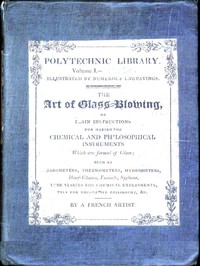
For The art of glass-blowing — Context and Discussion, the stored edition analysis reports 32,945 words, 2 hr 24 min estimated reading time, and 4 detected text sections.
The text analysis averages about 23.6 words per sentence, while the detected sections provide another way to judge how the source is divided.
Project Gutenberg metadata also associates the work with “Glass blowing and working,” connecting these edition facts with the source record’s subject description.
Explore this collection
These alternatives are selected using recorded categories and estimated reading time.
About 145 minutes
Electrical Technology
33,226 recorded words. 1 minutes difference from this book's estimate.
View Gutenberg source #61123About 138 minutes
Electrical Technology
31,698 recorded words. 6 minutes difference from this book's estimate.
View Gutenberg source #51242About 164 minutes
Electrical Technology
37,523 recorded words. 20 minutes difference from this book's estimate.
View Gutenberg source #27557Search stored excerpts and compare books → Choose by your preferences →
Choices use stored catalog measurements. Estimates vary with reading speed. A shared category is a catalog label, not a claim that two books have the same argument or literary quality.
Search reads excerpt text stored with this catalog and links to its associated Gutenberg record. The connection is stored in the site database; this tool does not recheck that every excerpt is word-for-word identical to that external record. Excerpt search does not cover every chapter and does not verify historical publication dates.
Catalog snapshot checked: 2026-09-26. Coverage: 91 public books, 91 available source excerpts.
Calculated from edition completeness, EPUB availability, text structure and catalogue metadata. Not a user rating.
Total of 100 points, scaled to a 2.5-5.0 range. Editions with an empty description or a missing EPUB file are not scored.
Public-domain source text
The source text is kept in the dedicated reader, separate from this catalogue record and its commentary.
This 1831 manual, written by a French artist and published in London as the first volume of the Polytechnic Library, addresses itself directly to two audiences: the scientific practitioner seeking economical apparatus, and the leisured amateur drawn to what it calls “the charming art of working Glass and Enamels with the Blowpipe.” The author’s voice is brisk and practical, yet the prose carries a quiet enthusiasm for the material itself—glass is described as something to be “softened,” “bent,” “drawn out,” and “soldered,” each verb implying a craft that is both delicate and forceful. The book’s structure mirrors the workshop: it moves from simple operations (bending a tube) to compound instruments (barometers, Barker’s mill), and the reader is expected to practice sequentially.
The author identifies himself only as “A French Artist,” and the text carries a tone that is at once authoritative and encouraging. He does not assume prior skill; instead, he anticipates failure and offers reassurance. For instance, when describing the Archimedes’ screw, he notes that “after a few attempts, you may finish by producing a pretty-regular spiral.” The word “pretty-regular” is telling—it suggests that perfection is not the immediate goal, and that the learner’s eye will improve with practice. The instructions are built around repeated actions: “soften,” “bend,” “cut off,” “border.” This iterative language mirrors the physical rhythm of glassworking itself. The author also inserts small warnings—about moisture in tubes, about the need to “free it with most particular care”—that reveal a craftsman’s intimate knowledge of failure points. His voice is that of a patient tutor who has watched many students struggle and knows exactly where they will stumble.
The book is organized not by instrument type alone, but by increasing complexity of manipulation. Early sections focus on fundamental operations: sealing a tube, bending it at a right angle, drawing out a point. Only after these are established does the text introduce compound devices like the syphon barometer or the stop-cock barometer. Each new instrument builds on earlier skills. For example, the Barker’s mill requires the reader to “contract a tube at its two extremities,” “pierce it laterally,” and “solder to the hole an additional tube”—all operations that have been practiced separately in preceding pages. The author also cross-references his own plates (e.g., “See pl. 3, fig. 33”), creating a visual dialogue between text and engraving. This layered structure means the book can be read straight through as a course, or consulted as a reference for a specific instrument. The final section on barometers is the most detailed, suggesting that the author considered these instruments the culmination of the glassblower’s art.
The prose moves in short, imperative bursts: “Take a tube,” “Seal one of its extremities,” “Fill it with mercury.” Sentences are typically 15–25 words, and each step is a discrete action. This staccato rhythm mirrors the physical pace of glassworking—quick, precise movements followed by moments of cooling or inspection. When the author describes a more complex process, such as making a cistern barometer, the sentences lengthen slightly to accommodate the sequence: “When the tube is full of mercury, and the boiling has taken place, turn it upside down, and plunge the open end into a cistern also filled with mercury which has been boiled.” The conjunction “and” strings actions together, implying a continuous flow of motion. There is no wasted description; the author does not pause to admire the beauty of the glass. Instead, the pace is utilitarian, driven by the goal of a working instrument. This efficiency of language is itself a kind of pedagogy: it trains the reader to think in terms of procedure, not theory.
Readers approaching this manual should come with a blowpipe and a willingness to fail. The author’s instructions are precise but assume a hands-on context; the text is best read beside a workbench, not an armchair. Pay close attention to the plates—they are not decorative but functional, and the author often refers to them mid-sentence. The book’s value lies not in its scientific theory (which is minimal) but in its transmission of embodied knowledge: how to feel the right temperature, how to judge a bend, how to recover from a crack. It is a record of a craft taught by demonstration, now preserved in prose.
That rainy afternoon, the glassblower’s manual kept me company, its patient instructions for melting and coaxing fragile tubes feeling oddly soothing. The way precise steps could yield such delicate instruments lingered in my mind. Later, my gaze drifted to a shelf, landing on The Borghesi Astronomical Clock in the Museum of History and Technology Contributions from the Museum of History and Technology, Paper 35 — Story, Setting & Ideas. Both, it struck me, are quiet homages to patience—turning small materials into tools that measure our world.
Create a short personal record of your experience with this book.