About 405 minutes
The Dominion of the Air: The Story of Aerial Navigation — Reading Notes
Inventions Industry
93,063 recorded words. 28 minutes difference from this book's estimate.
View Gutenberg source #861
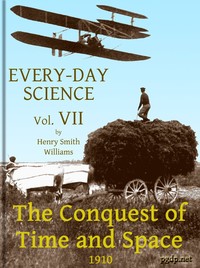
Before opening Every-day Science: Volume 7. The Conquest of Time and Space — Reading Notes, the edition data offers a quick orientation: 86,519 words, 6 hr 17 min estimated reading time, and 10 detected text sections.
The text analysis averages about 26.7 words per sentence, while the detected sections provide another way to judge how the source is divided.
Project Gutenberg metadata also associates the work with “Transportation,” connecting these edition facts with the source record’s subject description.
Explore this collection
These alternatives are selected using recorded categories and estimated reading time.
About 405 minutes
Inventions Industry
93,063 recorded words. 28 minutes difference from this book's estimate.
View Gutenberg source #861About 302 minutes
Inventions Industry
69,253 recorded words. 75 minutes difference from this book's estimate.
View Gutenberg source #56679About 476 minutes
Inventions Industry
109,275 recorded words. 99 minutes difference from this book's estimate.
View Gutenberg source #21224Search stored excerpts and compare books → Choose by your preferences →
Choices use stored catalog measurements. Estimates vary with reading speed. A shared category is a catalog label, not a claim that two books have the same argument or literary quality.
Search reads excerpt text stored with this catalog and links to its associated Gutenberg record. The connection is stored in the site database; this tool does not recheck that every excerpt is word-for-word identical to that external record. Excerpt search does not cover every chapter and does not verify historical publication dates.
Catalog snapshot checked: 2026-09-26. Coverage: 91 public books, 91 available source excerpts.
Calculated from edition completeness, EPUB availability, text structure and catalogue metadata. Not a user rating.
Total of 100 points, scaled to a 2.5-5.0 range. Editions with an empty description or a missing EPUB file are not scored.
Public-domain source text
The source text is kept in the dedicated reader, separate from this catalogue record and its commentary.
This volume of Every-day Science examines the history of transportation and navigation through a series of detailed technological accounts. The authors, Henry Smith Williams and Edward Huntington Williams, structure each chapter around specific inventions—the mariner's compass, the sextant, the steamship, the bicycle, and the aeroplane—tracing their development from early prototypes to refined forms. The catalog subject “Transportation” accurately reflects the content, but the excerpts reveal a stronger emphasis on the incremental, often delayed, adoption of innovations than on broad narratives of progress.
The excerpts devote considerable space to the bicycle’s evolution, contradicting any assumption that its success was immediate. The authors note that the “hobby-horse” of 1818 was “soon ridiculed out of court,” and Kirkpatrick MacMillan’s treadle-bicycle of 1840 “did not become popular.” Even after Pierre Lallament’s crank-driven “bone shaker” appeared in 1866, the machine was uncomfortable and dangerous. The turning point came only with the combination of the wire suspension wheel (1868), the pneumatic tire (1888), and the “safety” bicycle design (1885). The text emphasizes that the safety bicycle “practically eliminated” the risk of “taking a header,” a phrase that captures the practical concerns of early riders. This section illustrates how the catalog subject “Transportation” encompasses not just the final successful form but the many failed or delayed precursors.
Chapter I details the slow refinement of tools for determining position at sea. The authors describe the mariner’s compass, the “dip of the needle” observed by Robert Norman, and the modern compass invented by Lord Kelvin. They trace the development of the sextant from the astrolabe through Hadley’s quadrant, and the chronometer’s perfection by John Harrison, a “British carpenter” who won a prize for his timepieces. The text also explains dead reckoning, the log, and the use of the Nautical Almanac for finding longitude. These passages show that the catalog subject “Transportation” is interpreted broadly to include the navigational infrastructure that made long-distance travel possible. The authors treat each instrument as a solution to a specific problem, such as measuring a degree of latitude or taking the sun at noon.
The second chapter traces the shift from ancient sailing vessels to modern steamships. The authors mention Robert Fulton’s Clermont and its “historic trip up the Hudson,” but also note earlier attempts by Blasco de Gary and Colonel John Stevens. They describe the iron and steel hulls of later ships, the dimensions of the Great Eastern, and the introduction of twin-screw propulsion and the turbine. The text presents the steamship as the culmination of a long series of experiments, not a sudden breakthrough. This aligns with the catalog subject “Transportation” but adds nuance: the authors are interested in how each innovation overcame practical obstacles, such as the need for stronger materials or more efficient engines. The excerpts do not cover later chapters on aeroplanes or arctic exploration, so the full scope of “The Conquest of Time and Space” remains partially inferred.
Readers should approach this volume as a series of case studies in technological evolution rather than a continuous narrative. The authors’ method—presenting each invention’s precursors, setbacks, and eventual refinement—offers a model for understanding how transportation technologies develop. The excerpts suggest that the book’s strength lies in its concrete details about inventors, dates, and mechanisms, not in sweeping claims about progress. For a full picture, one would need to consult the chapters on aeroplanes and polar exploration, which are not represented in the provided text.
What stayed with me from Every-day Science was that quiet awe for how we slowly stretched our world—compass, then steam, then wings. It felt less like history and more like remembering. That same hush came back leafing through the German Science Reader An Introduction to Scientific German, for Students of Physics, Chemistry and Engineering — Text and Context, where language itself becomes another patient vessel for understanding.
Create a short personal record of your experience with this book.