About 86 minutes
Motor Truck Logging Methods Engineering Experiment Station Series, Bulletin No. 12 — Story, Setting & Ideas
Inventions Industry
19,645 recorded words. 2 minutes difference from this book's estimate.
View Gutenberg source #37359
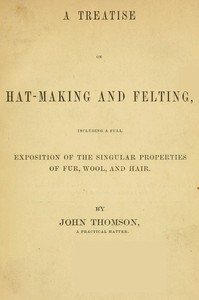
Before opening A Treatise on Hat-Making and Felting Including a Full Exposition of the Singular Properties of Fur, Wool, and Hair — A Closer Reading, the edition data offers a quick orientation: 20,143 words, 1 hr 28 min estimated reading time, and 3 detected text sections.
The text analysis averages about 33.0 words per sentence, while the detected sections provide another way to judge how the source is divided.
Project Gutenberg metadata also associates the work with “Hats,” connecting these edition facts with the source record’s subject description.
Explore this collection
These alternatives are selected using recorded categories and estimated reading time.
About 86 minutes
Inventions Industry
19,645 recorded words. 2 minutes difference from this book's estimate.
View Gutenberg source #37359About 84 minutes
Inventions Industry
19,320 recorded words. 4 minutes difference from this book's estimate.
View Gutenberg source #36446About 96 minutes
Inventions Industry
22,074 recorded words. 8 minutes difference from this book's estimate.
View Gutenberg source #31383Search stored excerpts and compare books → Choose by your preferences →
Choices use stored catalog measurements. Estimates vary with reading speed. A shared category is a catalog label, not a claim that two books have the same argument or literary quality.
Search reads excerpt text stored with this catalog and links to its associated Gutenberg record. The connection is stored in the site database; this tool does not recheck that every excerpt is word-for-word identical to that external record. Excerpt search does not cover every chapter and does not verify historical publication dates.
Catalog snapshot checked: 2026-09-26. Coverage: 91 public books, 91 available source excerpts.
Calculated from edition completeness, EPUB availability, text structure and catalogue metadata. Not a user rating.
Total of 100 points, scaled to a 2.5-5.0 range. Editions with an empty description or a missing EPUB file are not scored.
Public-domain source text
The source text is kept in the dedicated reader, separate from this catalogue record and its commentary.
John Thomson, identifying himself as a practical hatter, opens his 1868 treatise by asserting that theory and practice, though distinct, must be reconciled for perfection in any trade. He writes with a dual audience in mind: fellow workmen, whom he hopes will forgive any errors and find new ideas, and readers seeking to understand the why behind hat-making. Thomson explicitly avoids technical jargon, yet his prose is dense with process details, from the blowing machine to the fulling mill. The book’s structure follows the chronological manufacture of a felt hat, but Thomson also includes a history of hats, descriptions of furs and wools, and notes on fashions. His tone is earnest and occasionally defensive, aware that trade secrets and workshop prejudices may invite criticism.
Thomson begins with an axiom: theory and practice are essentially different, yet they “long for a mutual understanding.” He positions himself as a mediator, a practitioner who can explain the why behind workshop usages. He laments that workmen are “so diffident in writing,” implying that his treatise fills a gap. The opening paragraphs reveal a tension between revealing trade secrets and maintaining credibility among peers. Thomson acknowledges that many workshop “secrets” are merely trifles to gain a name, yet he proceeds to detail precise operations—shaving, stiffening, ruffing—with the authority of long experience. His voice is that of a craftsman who values both manual skill and explanatory clarity.
Thomson’s treatise is grounded in the physical properties of materials. He notes that “the quantity and quality of fur, or an entire change of materials, produce quite a different appearance” in the hat’s look, wear, and price. The shape of the cone must be adjusted for high or low crowns, broad or narrow brims. He describes how coarse hairs work to the surface during felting, necessitating shaving—a process where a workman “with a long bladed sharp knife in hand, sweeps rapidly over the surface.” The stiffening process, he explains, is not a paste but a varnish that coats each hair individually, leaving interstices open for ventilation. This attention to material behavior—why certain furs felt better, how water-proofing affects breathability—distinguishes the treatise from a mere recipe book.
Thomson draws a clear distinction between two types of felt hats. The “brush hat” raises a nap directly from the body itself: after shaving, the hatter uses a stiff brush, card, and comb to raise a nap on the half-solidified body, resulting in a rough, flowing surface. In contrast, hats destined for a finer nap receive a “plated cover of beaver” or other fine fur, applied as a veneer. Thomson calls this “a kind of veneering or outside plating.” The decision to plate or not affects the entire manufacturing sequence: plated hats must go back to the plank kettle for additional teasing and ducking. This contrast between a hat’s body and its surface finish—between structural integrity and aesthetic appearance—runs through the technical descriptions.
Thomson’s treatise is best read as a period document of industrial craft, where the author’s pride in his trade is matched by a desire to systematize knowledge. Readers interested in the history of technology will find value in his step-by-step accounts, while those curious about material culture can trace how fur, wool, and hair were transformed into everyday objects. The book rewards attention to its small details—the weight of a “precious morsel” of beaver, the width of rollers—as evidence of a working hatter’s world.
Thomson’s careful hands speak of patience—how a brush or a plume needs quiet attention before it becomes something lasting. I found myself thinking of that same slow craft when I stumbled upon The First Airplane Diesel Engine: Packard Model DR-980 of 1928 — A Reader’s Guide, another testament to how much devotion hides inside a single, overlooked object.
Use these questions to collect your thoughts before moving on.