About 75 minutes
The Early History of the Airplane — Key Ideas to Explore
Inventions Industry
17,198 recorded words. 1 minutes difference from this book's estimate.
View Gutenberg source #25420
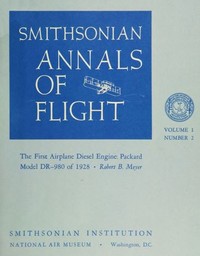
This digital edition of The First Airplane Diesel Engine: Packard Model DR-980 of 1928 — A Reader’s Guide is described by source-level measurements including 17,327 words, 1 hr 16 min estimated reading time, and 3 detected text sections.
The text analysis averages about 18.0 words per sentence, while the detected sections provide another way to judge how the source is divided.
Project Gutenberg metadata also associates the work with “Airplanes -- Motors (Diesel),” connecting these edition facts with the source record’s subject description.
Explore this collection
These alternatives are selected using recorded categories and estimated reading time.
About 75 minutes
Inventions Industry
17,198 recorded words. 1 minutes difference from this book's estimate.
View Gutenberg source #25420About 73 minutes
Inventions Industry
16,672 recorded words. 3 minutes difference from this book's estimate.
View Gutenberg source #65512About 84 minutes
Inventions Industry
19,320 recorded words. 8 minutes difference from this book's estimate.
View Gutenberg source #36446Search stored excerpts and compare books → Choose by your preferences →
Choices use stored catalog measurements. Estimates vary with reading speed. A shared category is a catalog label, not a claim that two books have the same argument or literary quality.
Search reads excerpt text stored with this catalog and links to its associated Gutenberg record. The connection is stored in the site database; this tool does not recheck that every excerpt is word-for-word identical to that external record. Excerpt search does not cover every chapter and does not verify historical publication dates.
Catalog snapshot checked: 2026-09-26. Coverage: 91 public books, 91 available source excerpts.
Calculated from edition completeness, EPUB availability, text structure and catalogue metadata. Not a user rating.
Total of 100 points, scaled to a 2.5-5.0 range. Editions with an empty description or a missing EPUB file are not scored.
Public-domain source text
The source text is kept in the dedicated reader, separate from this catalogue record and its commentary.
Robert B. Meyer's study of the Packard Model DR-980 diesel engine moves through three distinct textual modes: a chronological history of the engine's development, a technical description of its components and cycles, and an evaluative analysis of its advantages and disadvantages. The work's structure reflects a deliberate progression from narrative to engineering detail to comparative judgment, with each section building on the previous one. Recurring images of fire safety, weight reduction, and altitude performance tie these sections together, creating a coherent argument about the engine's innovative but ultimately limited design.
The book is divided into three main sections: History, Description, and Analysis. The History section (pages 2–10) recounts the engine's creation, including the agreement between Hermann Dorner and Packard, and the Collier Trophy presentation. The Description section (pages 11–22) provides specifications, operating cycles, and weight-saving features, using technical language and diagrams. The Analysis section (pages 33–36) lists advantages and disadvantages in a point-by-point format. This structure allows Meyer to first establish context, then explain the engine's mechanics, and finally evaluate its performance. The transitions between sections are marked by shifts in tone: from narrative prose to instructional detail to comparative argument.
Throughout the text, Meyer repeatedly emphasizes the diesel's lack of an electrical ignition system as a safety advantage. He notes that "shielding was unnecessary because the diesel had no electrical ignition system" and that the engine "could not backfire, further reducing the fire hazard." The absence of a carburetor is also highlighted: "Carburetor icing was an impossibility because there was no carburetor." These details recur in both the Description and Analysis sections, reinforcing the idea that the diesel's design inherently reduced fire risks. The image of a clean-running engine—"very clean-running from the standpoint of oil leakage"—appears alongside these safety claims, suggesting a broader theme of reliability through simplicity.
Meyer devotes significant attention to the engine's weight-to-power ratio, a key metric for aircraft engines. He compares the Packard diesel's 2.3 lb/hp to the English Beardmore "Tornado III" (6.9 lb/hp) and the German Junkers SL-1 (3.1 lb/hp), noting that the Packard was "as light as a gasoline one." This comparison appears in the Advantages section, but the theme of weight-saving features is introduced earlier in the Description section, where Meyer discusses reduced cooling fin area and the elimination of exhaust stacks. The movement between sections allows him to build a case for the diesel's competitiveness, while later acknowledging that weight savings alone could not ensure commercial success.
Meyer's analysis of the diesel's performance at altitude and during aerobatics reveals a recurring interest in the engine's behavior under extreme conditions. He explains that the diesel "uses an excess of air to eliminate a smoking exhaust" and thus maintains power at high altitudes, unlike carbureted gasoline engines. He also notes that the injectors "would work equally well whether right side up or upside down," making the engine "ideal for aerobatics." These observations tie the technical description to practical flight scenarios, showing how the diesel's design translated into operational advantages. The text moves from general principles (excess air, independent injectors) to specific applications (high-altitude flight, inverted maneuvers), creating a dynamic sense of the engine in action.
Meyer's monograph offers a focused look at a single engine, using a clear three-part structure to guide the reader from history to technical detail to evaluation. Readers interested in the interplay between engineering innovation and practical limitations will find the comparative analysis particularly useful. The recurring emphasis on fire safety, weight, and altitude performance provides a coherent framework for understanding the Packard diesel's place in aviation history.
The rain drummed on the windowsill while I traced Meyer’s careful diagrams of the Packard’s unusual combustion chamber. There’s a quiet satisfaction in watching someone explain a machine they love—how they circle back to the same valves, the same pressures. That patient, almost reverent repetition reminded me of another old handbook I once leafed through, The Principles of Leather Manufacture — Inside the Classic, where every soaking and salting step felt like a kind of faith. Odd, how two such different crafts share a stubborn, unhurried rhythm.
Your answers remain private and are stored only in this browser.