About 54 minutes
The Earliest Electromagnetic Instruments — Edition Insights
Inventions Industry
12,224 recorded words. 1 minutes difference from this book's estimate.
View Gutenberg source #34061
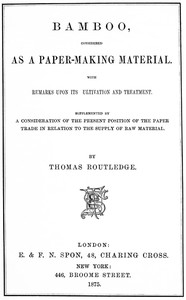
For Bamboo, Considered as a Paper-making Material With remarks upon its cultivation and treatment. Supplemented by a consideration of the present position of the paper trade — Reading Companion, the stored edition analysis reports 12,067 words, 53 min estimated reading time, and 2 detected text sections.
The text analysis averages about 35.4 words per sentence, while the detected sections provide another way to judge how the source is divided.
Project Gutenberg metadata also associates the work with “Papermaking,” connecting these edition facts with the source record’s subject description.
Explore this collection
These alternatives are selected using recorded categories and estimated reading time.
About 54 minutes
Inventions Industry
12,224 recorded words. 1 minutes difference from this book's estimate.
View Gutenberg source #34061About 46 minutes
Inventions Industry
10,479 recorded words. 7 minutes difference from this book's estimate.
View Gutenberg source #24442About 44 minutes
Inventions Industry
10,111 recorded words. 9 minutes difference from this book's estimate.
View Gutenberg source #48924Search stored excerpts and compare books → Choose by your preferences →
Choices use stored catalog measurements. Estimates vary with reading speed. A shared category is a catalog label, not a claim that two books have the same argument or literary quality.
Search reads excerpt text stored with this catalog and links to its associated Gutenberg record. The connection is stored in the site database; this tool does not recheck that every excerpt is word-for-word identical to that external record. Excerpt search does not cover every chapter and does not verify historical publication dates.
Catalog snapshot checked: 2026-09-26. Coverage: 91 public books, 91 available source excerpts.
Calculated from edition completeness, EPUB availability, text structure and catalogue metadata. Not a user rating.
Total of 100 points, scaled to a 2.5-5.0 range. Editions with an empty description or a missing EPUB file are not scored.
Public-domain source text
The source text is kept in the dedicated reader, separate from this catalogue record and its commentary.
Thomas Routledge opens his 1875 pamphlet by asserting that bamboo, among all fibre-yielding plants, is uniquely suited to meet the paper trade's demands. He supports this with specific growth rates: at Syon House, Bambusa Gigantea stems reached 60 feet in 12 weeks; at Kew, Bambusa Vulgaris grew three feet in a week. These measurements, attributed to named gardens and botanists, ground his argument in observable data rather than general praise.
Routledge identifies a key obstacle: previous attempts to make paper from bamboo failed because the plant was harvested when mature or over-mature, resulting in dense, indurated fibre. He implies that timing of harvest is as critical as the plant's natural properties, a technical insight that shapes his subsequent recommendations.
Routledge marshals evidence of bamboo's extraordinary growth from multiple locations. At Gehzireh, the Khedive of Egypt's gardens, it grew nine inches in a single night. At Chatsworth, Bambusa Vulgaris reached 40 feet in 40 days. These figures are not merely impressive; they serve to demonstrate the plant's potential for rapid, renewable fibre production.
He then catalogues bamboo's range: East Indies, West Indies, Central and South America, Brazil, Africa, Asia, China, Japan. The plant is indigenous to many regions and cultivated carefully in China and Japan for diverse uses. Routledge emphasizes that wherever heat and moisture exist, some bamboo species can be found or cultivated, suggesting a virtually unlimited supply for paper-making.
Routledge divides fibre-producing plants into two botanical classes: Endogens (inside growers) and Exogens (outside growers). Bamboo, along with grasses, reeds, and sugar cane, falls under Endogens. He lists numerous examples—Manilla Hemp, Aloe, Sisal Hemp, Esparto—to contextualize bamboo within a broader taxonomy.
He then describes the labour-intensive extraction process for Endogenous fibres: stems are crushed, beaten, macerated, scraped, and combed, often by hand. Some plants are buried in wet sand or mud to rot, which weakens the fibre. The yield is only 6–12 per cent, and the process is only economical where labour is cheap. This technical detail underscores the challenge of industrializing bamboo fibre production.
Routledge surveys the paper trade's reliance on various fibres, noting that England's colonies and dependencies offer an inexhaustible supply of fibre-producing plants. He cites historical precedents: China, Japan, and India have long made strong, tough paper from raw indigenous virgin fibres, though not in a European style.
He references Dr. Forbes Royle's The Fibrous Plants of India and Dr. J. Forbes Watson's paper to the Society of Arts, grounding his argument in contemporary scientific authority. The implication is clear: bamboo, properly harvested and treated, could solve the paper trade's raw material shortage, but only if industrial methods replace traditional hand labour.
Routledge's pamphlet is a technical argument rooted in specific measurements, botanical classification, and economic context. Readers should attend to how he uses growth data not as spectacle but as evidence of bamboo's industrial viability. His critique of past failures—harvesting mature plants—offers a lens for evaluating his proposed solutions. The work is best approached as a period piece in industrial advocacy, revealing how 19th-century inventors thought about raw materials, labour, and global supply chains.
I found myself thinking about how Routledge saw the future in something as humble as bamboo—patient, practical, quietly revolutionary. That same careful attention to material and process lingers in Photogravure — Text and Context, where image-making becomes its own slow craft. Strange how old methods still speak to us, almost like old friends we'd almost forgotten.
Capture what you thought, learned, and would like to remember.