About 366 minutes
Cotton Weaving and Designing 6th Edition — Inside the Classic
Mechanical Engineering
84,177 recorded words. 2 minutes difference from this book's estimate.
View Gutenberg source #57031
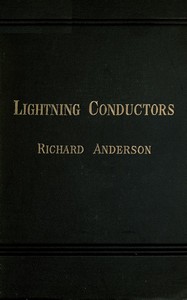
The catalog record for Lightning Conductors: Their History, Nature, and Mode of Application — A Reader’s Guide provides practical reading context through 84,628 words, 6 hr 8 min estimated reading time, and 24 detected text sections.
The text analysis averages about 23.7 words per sentence, while the detected sections provide another way to judge how the source is divided.
Project Gutenberg metadata also associates the work with “Lightning conductors,” connecting these edition facts with the source record’s subject description.
Explore this collection
These alternatives are selected using recorded categories and estimated reading time.
About 366 minutes
Mechanical Engineering
84,177 recorded words. 2 minutes difference from this book's estimate.
View Gutenberg source #57031About 273 minutes
Mechanical Engineering
62,602 recorded words. 95 minutes difference from this book's estimate.
View Gutenberg source #38953About 272 minutes
Mechanical Engineering
62,386 recorded words. 96 minutes difference from this book's estimate.
View Gutenberg source #34124Search stored excerpts and compare books → Choose by your preferences →
Choices use stored catalog measurements. Estimates vary with reading speed. A shared category is a catalog label, not a claim that two books have the same argument or literary quality.
Search reads excerpt text stored with this catalog and links to its associated Gutenberg record. The connection is stored in the site database; this tool does not recheck that every excerpt is word-for-word identical to that external record. Excerpt search does not cover every chapter and does not verify historical publication dates.
Catalog snapshot checked: 2026-09-26. Coverage: 91 public books, 91 available source excerpts.
Calculated from edition completeness, EPUB availability, text structure and catalogue metadata. Not a user rating.
Total of 100 points, scaled to a 2.5-5.0 range. Editions with an empty description or a missing EPUB file are not scored.
Public-domain source text
The source text is kept in the dedicated reader, separate from this catalogue record and its commentary.
Richard Anderson opens his 1880 manual with a frank assessment of the English market: there was no 'good practical work on Lightning Conductors' accessible to both professionals and non-specialists. He positions his book as a remedy, offering a history of protective methods alongside a 'thoroughly practical exposition' of systems used by leading authorities in various countries. The preface addresses architects, clergymen, and municipal officials, stressing that 'enormous amount of property is destroyed merely because the simplest precautions have not been taken.' Anderson claims a 'large practical acquaintance' with the subject, grounding the work in hands-on experience rather than abstract theory.
Anderson's voice is that of an engineer writing for other practitioners. He avoids speculative physics and instead focuses on what can be built, tested, and maintained. The preface explicitly targets readers who need 'usable information'—a phrase that recurs in spirit throughout the excerpts. When describing French ridge-circuits, Anderson specifies bar dimensions ('about three quarters of an inch square'), fastening methods ('overlaying the ends, bolting them together with two bolts, and covering them well with solder'), and even the weight of cast-iron bearings ('from ten to twelve pounds each'). This level of detail suggests a writer who expects his instructions to be followed on site.
The longest excerpt describes French paratonnerre practice, particularly the 'ridge-circuit' for large buildings. Anderson explains how this 'unbroken metallic connection' runs along ridges, connects to conductors and terminal rods, and ultimately links to 'the subterraneous sheet of water which forms the common reservoir.' He notes variations in support design—'forked uprights' to allow for thermal expansion, or grooved cast-iron bearings—and stresses that all metal masses in the building must be 'metallically connected' to the system. The earth terminal receives special attention: Anderson details methods to prevent corrosion, including tarred wooden spouts, sheet-lead wrappers, and a charcoal-filled trough approved by the Paris Academy of Sciences. He even recommends carrying the conductor through 'the lowest and dampest plots of ground' to improve contact.
The table of contents reveals a deliberate arc: early chapters cover electricity theory, the discovery of the lightning conductor, and early experiments, before shifting to practical matters like metals, thunderstorm character, and inquiries into protection. By Chapter IX, Anderson is discussing 'The Best Material for Conductors,' and the later portions (represented by the French-system excerpt) become almost handbook-like in their procedural density. This change in pace—from historical narrative to technical specification—mirrors Anderson's stated goal of providing both history and 'usable' instruction. The reader moves from learning about Franklin's experiments to calculating the proper thickness of iron bars, a transition that rewards those who read the earlier chapters as preparation for the later ones.
Anderson's manual is best approached as a reference work that rewards selective reading. Readers interested in the evolution of lightning protection may start with the historical chapters; those seeking installation guidance can jump to the later sections on materials and earth terminals. The French ridge-circuit description, with its precise measurements and alternative methods, exemplifies the kind of practical detail that makes the book valuable to modern restorers or historians of technology. Anderson's voice—confident, specific, and slightly impatient with negligence—gives the text a distinctive character that transcends its technical subject.
Reading Anderson’s careful nineteenth-century diagrams, I felt the quiet patience of someone solving problems by hand, grounded in earth and wire. That same deliberate craft lingers in U.S. Patent 4,293,314: Gelled Fuel-Air Explosive October 6, 1981. — Key Ideas to Explore, though the purpose turned toward something far less gentle. Still, I keep thinking how both ask for precision—and trust what cannot be seen.
Use these questions to collect your thoughts before moving on.