About 272 minutes
The Panama Canal: A history and description of the enterprise — Inside the Classic
Mechanical Engineering
62,386 recorded words. 22 minutes difference from this book's estimate.
View Gutenberg source #34124
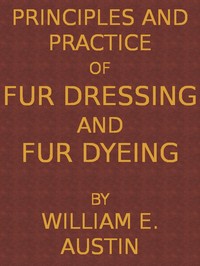
Principles and Practice of Fur Dressing and Fur Dyeing — A Closer Reading can be approached with a clearer sense of reading commitment from its source measurements: 57,307 words, 4 hr 10 min estimated reading time, and 7 detected text sections.
The text analysis averages about 23.3 words per sentence, while the detected sections provide another way to judge how the source is divided.
Project Gutenberg metadata also associates the work with “Fur -- Dressing and dyeing,” connecting these edition facts with the source record’s subject description.
Explore this collection
These alternatives are selected using recorded categories and estimated reading time.
About 272 minutes
Mechanical Engineering
62,386 recorded words. 22 minutes difference from this book's estimate.
View Gutenberg source #34124About 273 minutes
Mechanical Engineering
62,602 recorded words. 23 minutes difference from this book's estimate.
View Gutenberg source #38953About 196 minutes
Mechanical Engineering
44,914 recorded words. 54 minutes difference from this book's estimate.
View Gutenberg source #54244Search stored excerpts and compare books → Choose by your preferences →
Choices use stored catalog measurements. Estimates vary with reading speed. A shared category is a catalog label, not a claim that two books have the same argument or literary quality.
Search reads excerpt text stored with this catalog and links to its associated Gutenberg record. The connection is stored in the site database; this tool does not recheck that every excerpt is word-for-word identical to that external record. Excerpt search does not cover every chapter and does not verify historical publication dates.
Catalog snapshot checked: 2026-09-26. Coverage: 91 public books, 91 available source excerpts.
Calculated from edition completeness, EPUB availability, text structure and catalogue metadata. Not a user rating.
Total of 100 points, scaled to a 2.5-5.0 range. Editions with an empty description or a missing EPUB file are not scored.
Public-domain source text
The source text is kept in the dedicated reader, separate from this catalogue record and its commentary.
William E. Austin opens his 1922 manual by declaring that the fur dressing and dyeing industry has risen from relative insignificance to considerable importance as a branch of applied chemistry. He notes that the past eight years have witnessed the virtual transference of leadership from Europe to America, a claim he supports by stating that the great bulk of American furs formerly sent to Leipzig, Paris or London are now processed domestically. Austin writes with the authority of a consulting chemist, yet his preface acknowledges the almost monastic seclusion in which fur dressers and dyers traditionally operated, and the lack of reliable literature on the subject.
Austin describes early dyeing methods as exceedingly laborious: furs were killed by brushing on a paste containing essential ingredients, then dried, beaten, and brushed—a process repeated often a dozen or more times to achieve the proper depth of shade. The breakthrough came when a fur dyer with a little more courage attempted to dye furs by dipping them entirely into a bath. This dip method allowed large numbers of skins to be treated at once, reducing time and labor, and produced more uniformly dyed results. However, the condition of the leather after dyeing was not so encouraging, a difficulty that Austin says has to a considerable degree been overcome by proper dressing of the skins prior to dyeing. He notes that the dip method now handles millions of skins annually, but the brush method remains essential for seal and seal imitations on muskrat and coney.
Austin provides a detailed look at the brush method, including an illustration of various brushes, each with a specific purpose and use. The procedure involves placing skins hair-side up on a work-bench, then brushing the dye solution in the direction of the fall of the hair, occasionally beating gently to cause penetration to the desired depth. Considerable skill and care must be exercised, as it is rather easy to force the dye down further than wanted, potentially affecting the leather or the roots of the hair. Multiple applications may be necessary, with drying between each. Austin also notes that machines have recently been invented to replace the hand brush for large-scale seal imitation dyeing, though the dip method is used in conjunction with it.
Austin’s voice is that of a scientist seeking to dispel the heavy cloud of mystery surrounding fur dressing and dyeing. He criticizes the lack of trustworthy data in existing German and French books, many of which are hopelessly out of date or unobtainable. His own work is intended as a text-book for those who expect to make fur dressing and dyeing their vocation. The excerpts show a writer who values precision: he distinguishes between killing (a preparatory mordanting step) and dyeing, and explains that in many imitations both brush and dip methods must be used. His language is direct and instructional, reflecting the industry’s shift from craft to applied chemistry.
Austin’s manual rewards readers who attend to the interplay of chemistry and manual skill. The descriptions of beating, brushing, and dipping reveal a process where small variations in technique could ruin the leather or produce uneven color. For those interested in industrial history, the book offers a rare window into a trade that guarded its methods closely, and into the moment when American production overtook European leadership.
What struck me in that old fur dressing manual wasn’t the chemistry so much as the quiet patience of it—how each pelt needed its own rhythm. I felt that same lingering hush reading Flat Machine Knitting and Fabrics — Inside the Classic, where every stitch seems to carry a craftsman’s unhurried breath, waiting to be understood rather than rushed.
Capture what you thought, learned, and would like to remember.