About 98 minutes
On the Development and Distribution of Primitive Locks and Keys — Edition Insights
Mechanical Engineering
22,327 recorded words. 36 minutes difference from this book's estimate.
View Gutenberg source #44022
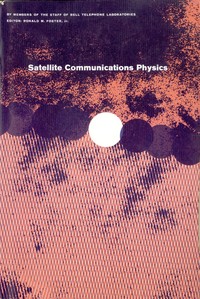
For Satellite Communications Physics — Background and Themes, the stored edition analysis reports 30,690 words, 2 hr 14 min estimated reading time, and 5 detected text sections.
The text analysis averages about 21.3 words per sentence, while the detected sections provide another way to judge how the source is divided.
Project Gutenberg metadata also associates the work with “Artificial satellites in telecommunication,” connecting these edition facts with the source record’s subject description.
Explore this collection
These alternatives are selected using recorded categories and estimated reading time.
About 98 minutes
Mechanical Engineering
22,327 recorded words. 36 minutes difference from this book's estimate.
View Gutenberg source #44022About 97 minutes
Mechanical Engineering
22,157 recorded words. 37 minutes difference from this book's estimate.
View Gutenberg source #32962About 186 minutes
Mechanical Engineering
42,591 recorded words. 52 minutes difference from this book's estimate.
View Gutenberg source #49866Search stored excerpts and compare books → Choose by your preferences →
Choices use stored catalog measurements. Estimates vary with reading speed. A shared category is a catalog label, not a claim that two books have the same argument or literary quality.
Search reads excerpt text stored with this catalog and links to its associated Gutenberg record. The connection is stored in the site database; this tool does not recheck that every excerpt is word-for-word identical to that external record. Excerpt search does not cover every chapter and does not verify historical publication dates.
Catalog snapshot checked: 2026-09-26. Coverage: 91 public books, 91 available source excerpts.
Calculated from edition completeness, EPUB availability, text structure and catalogue metadata. Not a user rating.
Total of 100 points, scaled to a 2.5-5.0 range. Editions with an empty description or a missing EPUB file are not scored.
Public-domain source text
The source text is kept in the dedicated reader, separate from this catalogue record and its commentary.
The prose in Satellite Communications Physics is marked by a deliberate, problem-solving diction that mirrors the engineering mindset of its Bell Labs authors. Phrases such as “we had to squeeze our mirrors aboard it as best we could” and “we solved this rather tricky problem” reveal a collaborative, iterative approach to design. The language is concrete and constraint-driven, with frequent references to physical limits: “they could not add more than half a pound to Telstar’s total load” or “the mirrors had to be as flat as possible, so the beam of reflected sunlight would not diverge by more than one degree.” This vocabulary of precision—weight, angle, reflection coefficient—shapes the narrative into a series of technical challenges met with ingenuity.
The descriptions in the excerpts are anchored by explicit physical constraints. When discussing the design of mirrors for Telstar I, the text lists requirements in a cumulative, almost legalistic manner: “very thin, very shiny, very flat, very light, and almost unbreakable.” This stacking of adjectives, each tied to a measurable property, reflects the engineers’ need to satisfy multiple competing demands. The description of the mirror’s fabrication—machined from aluminum alloy, polished by hand with abrasive papers, buffed on a cloth wheel, and coated with evaporated aluminum—reads as a step-by-step protocol, emphasizing process over flourish. The authors avoid metaphorical language; instead, they anchor every detail in the physical world, making the engineering trade-offs tangible.
Though the text is expository, it employs a first-person plural voice that functions as a kind of internal dialogue among the team. Sentences like “Our first thought was simply to make use of the light reflected from the sapphire covers” and “we decided to press ahead with this scheme” convey a collective decision-making process. The phrase “we thought we could pick up the minute flashes” introduces a hypothesis, while “we plotted the times when the satellite would be above the horizon” shows data-driven reasoning. This narrative voice turns technical exposition into a story of discovery, where each “we” implies a group of engineers weighing options, testing ideas, and refining their approach based on evidence.
The authors consistently use precise numbers and geometric terms to anchor their explanations. Angles are specified to the degree: “68 degrees—which is the angle made by the first facets above Telstar’s equatorial antenna band.” Distances and tolerances are given in fractions of an inch: “nor could they project more than one-eighth inch from the satellite’s surface.” The text also employs conditional reasoning, as in “if we measure the exact times when we see flashes of reflected sunlight from Telstar, we can combine that information.” This reliance on exact measurement and hypothetical logic mirrors the scientific method, turning abstract physics into concrete, solvable problems.
The editorial voice throughout the excerpts is that of a practitioner, not a theoretician. The authors describe their work in terms of hands-on actions: “we machined,” “we polished,” “we fastened.” The mirrors are “fastened to the surface of the satellite with small screws, which had to be tightened and shimmed very carefully.” This tactile vocabulary grounds the physics in manual labor. Even when discussing calculations, the language remains grounded: “we plotted the times” and “we made allowance for satellite orbits that might deviate slightly.” The cumulative effect is a text that reads as a technical memoir, where the authors’ authority comes from having done the work, not merely from knowing the theory.
Readers approaching this volume should attend to the way the authors use language to transform abstract physics into a series of tangible engineering decisions. The diction—precise, constraint-laden, and collaborative—reveals as much about the culture of Bell Labs as it does about satellite design. By focusing on the words chosen to describe problems and solutions, one can trace the intellectual path from concept to hardware, a path defined not by grand theories but by the careful negotiation of physical limits.
I’ve always loved how Satellite Communications Physics treats its equations like old friends—patient, exacting, never rushed. That same quiet devotion lives in A handbook of laboratory glass-blowing — Themes and Context, where a flame’s curve asks for the same tender precision. Both speak of hands working carefully, solving problems the way librarians reshelve—one gentle correction at a time.
Use these questions to collect your thoughts before moving on.