About 73 minutes
Lasers — A Reader’s Guide
Inventions Industry
16,672 recorded words. 6 minutes difference from this book's estimate.
View Gutenberg source #65512
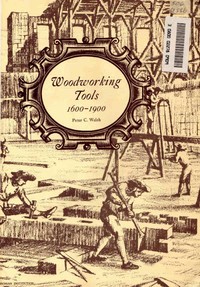
The catalog record for Woodworking Tools 1600-1900 — Context and Discussion provides practical reading context through 15,365 words, 1 hr 7 min estimated reading time, and 3 detected text sections.
The text analysis averages about 15.4 words per sentence, while the detected sections provide another way to judge how the source is divided.
Project Gutenberg metadata also associates the work with “Woodworking tools -- History,” connecting these edition facts with the source record’s subject description.
Explore this collection
These alternatives are selected using recorded categories and estimated reading time.
About 73 minutes
Inventions Industry
16,672 recorded words. 6 minutes difference from this book's estimate.
View Gutenberg source #65512About 75 minutes
Inventions Industry
17,198 recorded words. 8 minutes difference from this book's estimate.
View Gutenberg source #25420About 76 minutes
Inventions Industry
17,327 recorded words. 9 minutes difference from this book's estimate.
View Gutenberg source #31023Search stored excerpts and compare books → Choose by your preferences →
Choices use stored catalog measurements. Estimates vary with reading speed. A shared category is a catalog label, not a claim that two books have the same argument or literary quality.
Search reads excerpt text stored with this catalog and links to its associated Gutenberg record. The connection is stored in the site database; this tool does not recheck that every excerpt is word-for-word identical to that external record. Excerpt search does not cover every chapter and does not verify historical publication dates.
Catalog snapshot checked: 2026-09-26. Coverage: 91 public books, 91 available source excerpts.
Calculated from edition completeness, EPUB availability, text structure and catalogue metadata. Not a user rating.
Total of 100 points, scaled to a 2.5-5.0 range. Editions with an empty description or a missing EPUB file are not scored.
Public-domain source text
The source text is kept in the dedicated reader, separate from this catalogue record and its commentary.
Peter C. Welsh opens his study with a frank acknowledgment of the difficulties facing any historian of woodworking tools: the objects themselves are anonymous, worn, and rarely dated. He cites W.M.F. Petrie's 1918 lament that the history of tools 'has yet to be studied,' and then systematically enumerates the reasons—daily wear, multi-generational use, resistance to radical change, and scarcity of dated wooden elements—that make precise identification elusive. This candid framing sets the tone for a work that proceeds not by grand narrative but by careful, evidence-based inference.
Welsh devotes considerable attention to the challenge of tracing the origins of American tool shapes. He poses three specific questions: what did a given tool look like before standardization in England and the United States? When did English and Continental shapes diverge? And when, if ever, did American tools acquire a distinctly national character? These questions are not rhetorical; they structure the entire inquiry. The author repeatedly notes that the literature is 'constantly diminishing,' forcing reliance on museum collections and archaeological survivals. The result is a study that is as much about the limits of knowledge as about the tools themselves.
One of the most striking passages in the excerpts concerns the screwdriver, which Welsh describes as a latecomer to the woodworker's bench, appearing regularly only after 1800. Unlike other Anglo-American tools, it lacked a long evolutionary tradition. Early versions sometimes featured a scalloped blade 'for no other purpose than decoration.' Similarly, the plow plane patented in 1870 by Charles Miller and manufactured by the Stanley Rule and Level Company was covered with a shell and vine motif, a departure from the 'strong, plain lines' that had evolved over two centuries. Welsh speculates on possible reasons—appeal to immigrant craftsmen, transfer of decorative woodworking techniques, or a Victorian discomfort with bare metal—but leaves the question open, noting that the ornate phase was short-lived. At the 1876 Centennial Exhibition, the prize tools reflected little ornamentation, and American edge tools were praised for their quality and attractiveness.
Welsh draws a telling contrast between two representations of the carpenter's equipment. One is the 'gentleman's tool chest' advertised in the pattern book of the Castle Hill Works, featuring bracket feet, brass pulls, and inlaid keyholes that imitate domestic furniture of 1790–1810—features included, Welsh suggests, to appeal to a gentleman of refined taste. The other is a plate from Shaw's The Modern Architect, where the builder-carpenter is still depicted as a gentleman, but the tool chest itself reflects only 'the severest of functional lines.' This juxtaposition illustrates Welsh's broader argument that while ruling taste occasionally influenced tool design, the dominant trend was toward functional simplicity. The author's attention to such details—the scalloped screwdriver, the rococo plow plane, the gentleman's chest—reveals a historian alert to the social and aesthetic currents that sometimes interrupted the otherwise gradual evolution of hand tools.
Welsh's paper rewards readers who attend to his method as much as his conclusions. He builds his argument from specific objects—a screwdriver, a plow plane, an axe—and from the documentary traces left by manufacturers and exhibitions. The result is a work that respects the anonymity of its subjects while illuminating the forces that shaped them. Readers interested in material culture, the history of technology, or the craft of inference from fragmentary evidence will find much to admire.
Peter C. Welsh’s careful tracing of a plane’s changing form reminded me of quiet afternoons spent cataloguing, that same patient attention to small shifts. It brought back a handbook I once handled, The Dyeing of Cotton Fabrics: A Practical Handbook for the Dyer and Student — A Reader’s Guide, where every hue and mordant felt like a tool for another kind of making.
Use these questions to collect your thoughts before moving on.