About 440 minutes
The Panama Canal — Reading Companion
Civil Engineering
101,027 recorded words. 14 minutes difference from this book's estimate.
View Gutenberg source #41807
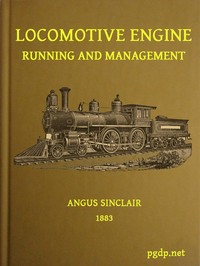
Before opening Locomotive Engine Running and Management — A Closer Reading, the edition data offers a quick orientation: 104,227 words, 7 hr 34 min estimated reading time, and 38 detected text sections.
The text analysis averages about 22.3 words per sentence, while the detected sections provide another way to judge how the source is divided.
Project Gutenberg metadata also associates the work with “Locomotives -- Handbooks, manuals, etc.,” connecting these edition facts with the source record’s subject description.
Explore this collection
These alternatives are selected using recorded categories and estimated reading time.
About 440 minutes
Civil Engineering
101,027 recorded words. 14 minutes difference from this book's estimate.
View Gutenberg source #41807About 299 minutes
Civil Engineering
68,579 recorded words. 155 minutes difference from this book's estimate.
View Gutenberg source #38782About 253 minutes
Civil Engineering
57,990 recorded words. 201 minutes difference from this book's estimate.
View Gutenberg source #64174Search stored excerpts and compare books → Choose by your preferences →
Choices use stored catalog measurements. Estimates vary with reading speed. A shared category is a catalog label, not a claim that two books have the same argument or literary quality.
Search reads excerpt text stored with this catalog and links to its associated Gutenberg record. The connection is stored in the site database; this tool does not recheck that every excerpt is word-for-word identical to that external record. Excerpt search does not cover every chapter and does not verify historical publication dates.
Catalog snapshot checked: 2026-09-26. Coverage: 91 public books, 91 available source excerpts.
Calculated from edition completeness, EPUB availability, text structure and catalogue metadata. Not a user rating.
Total of 100 points, scaled to a 2.5-5.0 range. Editions with an empty description or a missing EPUB file are not scored.
Public-domain source text
The source text is kept in the dedicated reader, separate from this catalogue record and its commentary.
Angus Sinclair opens his 1884 manual not with theory but with a confession: as a working locomotive engineer, he often observed peculiarities in his engine that he did not entirely understand. His response was to keep notes—first while running, later while managing a roundhouse in Iowa. Those notes became the raw material for this book, which aims to explain the causes behind everyday mechanical troubles. The excerpts reveal a text grounded in hands-on experience, where the author addresses fellow engineers directly, warning against common mistakes such as over-tightening side rods to silence rattling. Sinclair’s voice is practical and occasionally wry, as when he notes that most engineers err on the side of danger by tightening rods to prevent noise, even though loose rods are safer.
Sinclair explains in the preface that his book grew from a habit of noting down facts about engine performance while still an active engineer. After taking charge of a roundhouse on the Burlington, Cedar Rapids, and Northern Railway in Iowa, he continued the practice, now focused on emergency repairs and diagnosing what he calls “the numerous diseases that locomotives are heir to.” The catalog subject classifies this work under “Locomotives – Handbooks, manuals, etc.,” but the excerpts show a text that is more than a dry reference. Sinclair’s method is observational and diagnostic: he describes symptoms (a “pound” in the driving-boxes or wedges) and then traces causes to specific mechanical failures, such as worn pedestal faces or wedges thrown out of parallel. The book’s structure reflects this problem-solving approach, moving from running techniques to repair procedures.
A detailed passage on keying side rods illustrates Sinclair’s blend of practical instruction and cautionary anecdote. He advises engineers to select a straight, even track, put cranks on center, and check that rod connections can move laterally after keying. The goal is to preserve “the true mean between loose and tight side-rod connections.” Sinclair warns that with a worn-out engine and rough roadbed, this balance is hard to maintain, but “in a case of doubt, the loose side is the safe side.” He then recounts an observation from a Western road where solid-ended brasses were used: engineers protested the noise of rattling side rods, yet those rods never broke pins or caused accidents, unlike rods keyed too tight. The passage directly links a specific practice (keying to silence) to a specific danger (broken pins, fractured rods, derailed trains).
Sinclair devotes considerable space to the most common and serious pounds—those in driving-boxes and wedges. He identifies the cause as a rocking of the box in the wedges, often due to imperfect fitting or wear. On a locomotive that has done service, the wedge face wears hollow or develops furrows, especially on the “live” wedge side. Sinclair notes that this is the rule, not the exception. He explains that these defects throw the wedges out of parallel, necessitating adjustment during service. The remedy involves refitting: straightening the pedestal face its entire length and fitting the wedge-back to it. The passage is notable for its precise mechanical language and its assumption that the reader is already familiar with locomotive components. Sinclair does not define terms like “pedestal binder-brace” or “dead wedge,” but instead focuses on the sequence of wear and repair.
Sinclair’s manual rewards a reader willing to follow detailed mechanical reasoning. The excerpts show a work that is neither a beginner’s primer nor a theoretical engineering text, but a seasoned practitioner’s guide to keeping locomotives running under real-world conditions. Readers interested in the history of railroad technology will find specific, evidence-based descriptions of common failures and repairs. The book’s value lies in its concrete observations—such as the link between wedge wear and pounding—rather than in general principles.
There’s a quiet patience in Sinclair’s side-rod keying, the way he checks each fit before trusting the wheel. It reminded me of another kind of reaching—not steel on steel, but canvas against air. That old dream, measured in wingbeats instead of pounds, sits beside his notes like a softer echo. The Problem of Manflight — Story, Setting & Ideas holds that same careful wonder, though its sparks are lighter.
Capture what you thought, learned, and would like to remember.