About 454 minutes
Locomotive Engine Running and Management — A Closer Reading
Civil Engineering
104,227 recorded words. 260 minutes difference from this book's estimate.
View Gutenberg source #62609
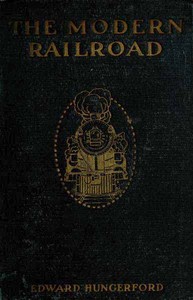
For The Modern Railroad — Reading Companion, the stored edition analysis reports 164,208 words, 11 hr 54 min estimated reading time, and 24 detected text sections.
The text analysis averages about 21.3 words per sentence, while the detected sections provide another way to judge how the source is divided.
Project Gutenberg metadata also associates the work with “Railroads -- United States,” connecting these edition facts with the source record’s subject description.
Explore this collection
These alternatives are selected using recorded categories and estimated reading time.
About 454 minutes
Civil Engineering
104,227 recorded words. 260 minutes difference from this book's estimate.
View Gutenberg source #62609About 440 minutes
Civil Engineering
101,027 recorded words. 274 minutes difference from this book's estimate.
View Gutenberg source #41807About 299 minutes
Civil Engineering
68,579 recorded words. 415 minutes difference from this book's estimate.
View Gutenberg source #38782Search stored excerpts and compare books → Choose by your preferences →
Choices use stored catalog measurements. Estimates vary with reading speed. A shared category is a catalog label, not a claim that two books have the same argument or literary quality.
Search reads excerpt text stored with this catalog and links to its associated Gutenberg record. The connection is stored in the site database; this tool does not recheck that every excerpt is word-for-word identical to that external record. Excerpt search does not cover every chapter and does not verify historical publication dates.
Catalog snapshot checked: 2026-09-26. Coverage: 91 public books, 91 available source excerpts.
Calculated from edition completeness, EPUB availability, text structure and catalogue metadata. Not a user rating.
Total of 100 points, scaled to a 2.5-5.0 range. Editions with an empty description or a missing EPUB file are not scored.
Public-domain source text
The source text is kept in the dedicated reader, separate from this catalogue record and its commentary.
Edward Hungerford's The Modern Railroad (1911) opens with a clear purpose: to explain the intricacy of railroad operation to the general public. The preface explicitly sets aside finance, politics, and labor disputes, concentrating instead on the physical and mechanical details of moving trains. The book's structure moves from historical beginnings through construction, tunnels, and signaling, as seen in the excerpt on interlocking and block signals.
Hungerford's voice is direct and observant, often blending technical explanation with on-the-ground reporting. He includes a telling anecdote about a veteran engineer who disregards a raised signal blade on a straight stretch, confident the track is clear. This moment reveals both the author's access to railroad men and his willingness to show the gap between rules and practice.
The excerpt on signals is the most detailed in the provided text, and it illustrates Hungerford's method. He describes semaphore blades, home and distant signals, and the block system with precision: the upper blade raised means stop, the lower raised means caution. He explains how signals are interlocked at junctions and carried on gantries over multiple tracks, with each track having its own 'doll.'
But Hungerford does not stop at mechanics. He includes a conversation with an engineer who ignores a stop signal on a straight stretch, saying, 'Why should I stop for that thing... when I can look down this straight stretch and see they’re clear?' The engineer's pride in his road's rolling stock—'end to end would reach from New York to Omaha'—and his contempt for rule books add a human dimension. This blend of technical clarity and character sketch is typical of the book's approach.
Hungerford repeatedly returns to the viewpoint of the men who run the trains. The engineer who dismisses a signal because he can see the track is clear is not presented as reckless but as 'keenest of the keen.' The author notes that rear-end collisions are rare on block-signaled lines, yet engineers 'do take chances time and time again.' This tension between written rules and practical judgment is a recurring theme.
The book's preface promises to avoid 'railroad politics' and 'quarrels between the railroads, the organizations of their employees, the governmental commissions,' but the signal anecdote subtly introduces a workplace culture where experience overrides regulation. Readers should watch for similar moments where Hungerford's reporting complicates his stated focus on pure operation.
The table of contents shows a logical progression: chapters on beginnings, development, building, tunnels, and then presumably signaling and other operational topics. The book covers both the grand narrative—canals, the Baltimore & Ohio, the transcontinental railroad—and the fine details of track-laying and signal bridges. Hungerford draws on earlier works like The American Railway (1887) and The Strategy of Great Railroads, but his own reporting gives the book a contemporary feel.
The excerpt's closing line—'Ready for the day’s run'—appears as a caption under a photograph, suggesting the book is heavily illustrated. The preface thanks editors at Harper’s Monthly and The Saturday Evening Post, indicating some chapters originated as magazine articles. This may explain the episodic, vivid style.
The provided text covers only the preface, contents, and a portion of the signaling chapter. The book's 164,208 words span 24 sections, including chapters on tunnels, freight cars, passenger service, and 'The Railroad in War Time.' The excerpts give no sense of those later sections. Hungerford's treatment of labor—despite disclaiming it—may appear in chapters on employees or safety.
Readers should note that the signaling chapter includes a detailed description of block system rules but also a frank admission that engineers sometimes ignore signals. Whether the book elsewhere addresses the consequences of such actions—accidents, discipline, or reforms—is unknown from these excerpts. The author's stance on regulation versus experience remains ambiguous.
Hungerford's The Modern Railroad rewards readers who attend to its small moments: a signal ignored, a veteran's pride, a gantry's design. The book is neither a dry manual nor a celebratory history, but a reporter's account of a complex system in daily operation. Approach it as a series of close observations rather than a comprehensive treatise, and let the engineers' voices guide your reading.
Hungerford’s book stayed with me because he made signals and engines feel like quiet, living things—not machines. There’s a gentleness in how he listens to old engineers. I remembered that when I found Locomotive Engine Running and Management — A Closer Reading, which treats the same craft with that patient, unhurried tenderness. It felt like sitting beside someone who truly loved the rails.
Your answers remain private and are stored only in this browser.