About 131 minutes
The Story of the Airship (Non-rigid) A Study of One of America's Lesser Known Defense Weapons — A Closer Reading
Civil Engineering
30,127 recorded words. 16 minutes difference from this book's estimate.
View Gutenberg source #51547
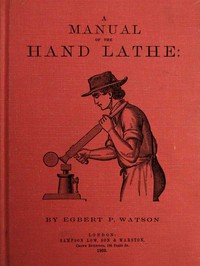
The source record for A Manual of the Hand Lathe Comprising Concise Directions for Working Metals of All Kinds, Ivory, Bone and Precious Woods — Reading Companion measures this digital text at 26,357 words, 1 hr 55 min estimated reading time, and 21 detected text sections.
The text analysis averages about 24.8 words per sentence, while the detected sections provide another way to judge how the source is divided.
Project Gutenberg metadata also associates the work with “Turning (Lathe work),” connecting these edition facts with the source record’s subject description.
Explore this collection
These alternatives are selected using recorded categories and estimated reading time.
About 131 minutes
Civil Engineering
30,127 recorded words. 16 minutes difference from this book's estimate.
View Gutenberg source #51547About 132 minutes
Civil Engineering
30,360 recorded words. 17 minutes difference from this book's estimate.
View Gutenberg source #28607About 93 minutes
Civil Engineering
21,202 recorded words. 22 minutes difference from this book's estimate.
View Gutenberg source #57421Search stored excerpts and compare books → Choose by your preferences →
Choices use stored catalog measurements. Estimates vary with reading speed. A shared category is a catalog label, not a claim that two books have the same argument or literary quality.
Search reads excerpt text stored with this catalog and links to its associated Gutenberg record. The connection is stored in the site database; this tool does not recheck that every excerpt is word-for-word identical to that external record. Excerpt search does not cover every chapter and does not verify historical publication dates.
Catalog snapshot checked: 2026-09-26. Coverage: 91 public books, 91 available source excerpts.
Calculated from edition completeness, EPUB availability, text structure and catalogue metadata. Not a user rating.
Total of 100 points, scaled to a 2.5-5.0 range. Editions with an empty description or a missing EPUB file are not scored.
Public-domain source text
The source text is kept in the dedicated reader, separate from this catalogue record and its commentary.
Watson opens his manual with a direct, no-apologies preface: he wrote it because he had something to say that was not generally known. The tone is that of a seasoned mechanic addressing fellow enthusiasts, not a distant instructor. He grounds every claim in personal experience, noting that he can show samples of everything described. This insistence on firsthand knowledge shapes the entire work, from tool selection to wood treatment.
Watson addresses his reader as a fellow workman, not a novice. In the preface he salutes all persons who love the art, and throughout he uses the first person to share what he has found effective. For example, he explains that for small work like penholders he tried dogs and other devices before settling on a method of rounding the wood end with a pocket-knife and inserting it in a chuck. This anecdotal style gives the manual a conversational, practical feel. He also sets limits: he does not cover every possible use of the lathe, leaving something for the workman to find out himself. The dedication to his son, hoping he may be a good man and a good mechanic, reinforces the personal, craft-oriented ethos.
Watson is meticulous about tool design. He criticizes the common driving center (Fig. 54) as a very poor device because its corners lack a guard, causing slippage under strain. He prescribes a modified center (Fig. 55) with flat pieces at the top to prevent slipping. This attention to small mechanical details recurs throughout the excerpts. In wood turning, he insists the speed cannot be too high and the tool too sharp, and he warns that improper centering can spoil a job when the centers change mid-work. His advice is concrete: saw wood into square strips rather than splitting, because splitting shivers and cracks hard and precious wood. These observations show a writer who has learned from trial and error.
Watson devotes a chapter to ornamental woods, describing specific varieties like snake wood, tulip wood, granadilla, and ebony. He notes that snake wood is very liable to worm holes and that too much care cannot be taken in examining it. He advises that many woods show well in large works but in small wares like sleeve buttons they look like common wood, so it is labor lost to spend time on fine veining that will not be brought out. His treatment of wood selection is practical: the first care is to select sound wood, because a worm hole appearing late in a job is vexatious and plugging it always mars the appearance. He also observes that native woods are peculiarly free from worm holes, contrasting with tropical imports.
Watson is frank about what his manual does not cover. He does not give recipes for varnishes, arguing that they cannot be made by inexperienced persons and can be bought cheaply and universally. He also acknowledges that the book does not cover every possible change and use of the lathe. This honesty is part of his authorial stance: he offers reliable guidance based on experience, but expects the workman to develop his own skill. The manual is structured in short chapters—from The Foot Lathe to Fancy Turning—each focused on a specific aspect of lathe work. The final chapters include patterns, but Watson admits he has not made all of them, calling that mere routine. This selective thoroughness gives the book a focused, practical character.
Watson’s manual rewards a careful reading of its small, precise instructions. Pay attention to his warnings about tool slippage, centering, and wood defects—these are the hard-won lessons of a practitioner. The book is best used alongside a lathe, testing his methods against your own materials. His voice, at once confident and modest, makes this a distinctive record of 19th-century amateur craftsmanship.
That rainy afternoon, the Manual of the Hand Lathe kept me company—its quiet insistence on patience with metal and ivory felt like a friend’s steady hand. Turning pages, I stumbled into a footnote about iron’s voyage through the city, which led me to Metropolitan Subway and Elevated Systems Bulletin 49 — Edition Insights. Strange how one craft’s patience bleeds into another’s tunnels.
Use these questions to collect your thoughts before moving on.