About 132 minutes
The Road and the Roadside — Story, Setting & Ideas
Civil Engineering
30,360 recorded words. 1 minutes difference from this book's estimate.
View Gutenberg source #28607
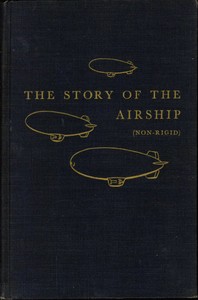
The source record for The Story of the Airship (Non-rigid) A Study of One of America's Lesser Known Defense Weapons — A Closer Reading measures this digital text at 30,127 words, 2 hr 11 min estimated reading time, and 5 detected text sections.
The text analysis averages about 21.9 words per sentence, while the detected sections provide another way to judge how the source is divided.
Project Gutenberg metadata also associates the work with “Military airships -- United States,” connecting these edition facts with the source record’s subject description.
Explore this collection
These alternatives are selected using recorded categories and estimated reading time.
About 132 minutes
Civil Engineering
30,360 recorded words. 1 minutes difference from this book's estimate.
View Gutenberg source #28607About 115 minutes
Civil Engineering
26,357 recorded words. 16 minutes difference from this book's estimate.
View Gutenberg source #48179About 93 minutes
Civil Engineering
21,202 recorded words. 38 minutes difference from this book's estimate.
View Gutenberg source #57421Search stored excerpts and compare books → Choose by your preferences →
Choices use stored catalog measurements. Estimates vary with reading speed. A shared category is a catalog label, not a claim that two books have the same argument or literary quality.
Search reads excerpt text stored with this catalog and links to its associated Gutenberg record. The connection is stored in the site database; this tool does not recheck that every excerpt is word-for-word identical to that external record. Excerpt search does not cover every chapter and does not verify historical publication dates.
Catalog snapshot checked: 2026-09-26. Coverage: 91 public books, 91 available source excerpts.
Calculated from edition completeness, EPUB availability, text structure and catalogue metadata. Not a user rating.
Total of 100 points, scaled to a 2.5-5.0 range. Editions with an empty description or a missing EPUB file are not scored.
Public-domain source text
The source text is kept in the dedicated reader, separate from this catalogue record and its commentary.
Hugh Allen's 1943 study of the non-rigid airship, or blimp, is a hybrid document: part technical manual, part institutional history, part wartime advocacy. Written by a Goodyear executive and dedicated to Admiral William A. Moffett and a roll call of airship casualties, the book opens with a foreword that places the blimp within the urgent context of 1940s global defense. Yet the excerpts reveal a work more concerned with engineering problem-solving—portable masts, water-ballast recovery, crew exchanges at sea—than with combat narrative. The catalog subject 'Military airships — United States' accurately describes the topic, but the text's emphasis on peacetime development and industrial persistence complicates any simple reading of it as a weapons manual.
The dedication page is unusually detailed, naming not only Admiral Moffett but also a list of men from multiple nations—Landsdowne, McCord, Berry, Calnan, Dugan, Maxfield, Hoyt, Hancock, Lawrence, Hawthorne Gray, Scott, de Grenadin, Lehmann, Brannigan, Morton—described as 'names taken from lighter-than-air’s brief but distinguished casualty list.' This is not a conventional tribute; it is a deliberate catalog of loss, framing the entire book as a memorial. The dedication also acknowledges living figures like Rosendahl, Fulton, Mills, Settle, Litchfield, and Arnstein, creating a community of believers who 'have carried on with unshaken faith, in the face of great setbacks.' The language of sacrifice and persistence pervades the front matter, suggesting that the technical chapters that follow are not neutral descriptions but arguments for a cause.
One of the most concrete technical claims in the excerpts concerns the portable mast, which allowed non-rigid airships to operate away from permanent hangars. Allen writes that Navy ships basing at Lakehurst 'have operated for weeks at a time along the coast as far north as Bath, Maine, and as far south as the Carolinas, with a portable mast as headquarters.' He asserts that this innovation 'not only greatly increased their radius of operation, and cut down landing crews, but increased the number of operating days per month.' The language is precise and quantitative, typical of an engineer's report. Yet the passage also contrasts early airship pilots, who judged wind by a handkerchief or anemometer, with modern crews who 'lose few flying days because it is too windy to go out.' This narrative of progress from cautious beginnings to wartime capability is a recurring structural device.
A striking section describes the challenge of taking on water ballast from the ocean. Allen explains that an airship grows lighter as it consumes fuel, and that helium—unlike hydrogen—could not be wasted by valving. The solution, developed under Lt. C. S. Rounds, involved a hose with a bronze scoop and a streamlined cylinder nicknamed 'the fish,' which 'skims along the surface or jumps out like a porpoise.' The description is vivid and technical, emphasizing the difficulty of maintaining contact between two vehicles moving in different media—'one influenced mostly by the waves, the other mostly by the wind.' This passage exemplifies the book's method: a concrete engineering problem is stated, a solution is described in mechanical detail, and the larger context of helium conservation and extended flight is made clear. The text does not claim that this system was widely deployed, only that it was tested and promising.
Readers should approach this book as a primary source on the institutional and technical culture of American airship development in the early 1940s. The excerpts show a work that is simultaneously a technical report, a piece of advocacy, and a memorial. Allen's perspective is that of an insider—he was a Goodyear executive—and the text reflects that company's long investment in lighter-than-air technology. The catalog subject 'Military airships — United States' is accurate, but the book's value lies as much in its depiction of engineering persistence and organizational memory as in its account of military capability.
That rainy afternoon, Allen’s blimps felt less like machines and more like patience—waiting storms, tugging at masts. As the windows blurred, I kept wondering about the hands that built them. Somewhere in the garage, a dog-eared copy of Flying Machines: Construction and Operation A Practical Book Which Shows, in Illustrations, Working Plans and Text, How to Build and Navigate the Modern Airship — Reading Notes surfaced, its cracked spine listing crude diagrams—a quieter, older dream behind the Navy’s careful war. Same silver longing, just less certain.
Use these questions to collect your thoughts before moving on.