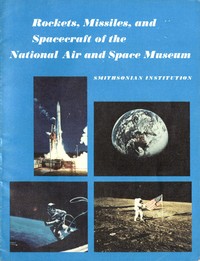
The booklet opens with a foreword by Michael Collins, Apollo 11 astronaut and then-director of the National Air and Space Museum, who frames the collection as a record of “ever more rapid and powerful ascents into the third dimension.” The text that follows is not a narrative history but a catalog of artifacts grouped by exhibit case, each entry pairing a photograph with a paragraph of technical specifications and provenance. The first case, for instance, covers Hale and Congreve war rockets, noting that the American Hale rocket used “two sets of gas nozzles” for spin stabilization—a detail that immediately signals the book’s emphasis on mechanical ingenuity over human drama.
From War Rockets to Test Stands
The early sections of the booklet move chronologically through military and experimental rocketry. The Congreve and Hale rockets, displayed as models or loans from British institutions, are described with precise dimensions and propellant details: the Congreve weighs 14.5 kilograms, the Hale rocket produces 136 kilograms of thrust. The text then shifts to the American Rocket Society (ARS), founded in 1930, whose first liquid-propellant engines were “machined from blanks of heat-resistant, cast-aluminum alloy.” A notable detail is that ARS Engine No. 4 was mounted in the nose rather than the tail—an unconventional design that ended when a nozzle burned out during a 1934 test flight. The section also introduces regenerative cooling, a system proposed by ARS member James Wyld in 1938, which later enabled longer-duration burns.
The H-1 Engine and Saturn Booster
Later excerpts describe the H-1 liquid-propellant engine, an outgrowth of the LR-79 that powered early Saturn rockets. The text notes that the H-1 was clustered in the first stage of the Saturn 1B, which lifted the Skylab 4 crew in 1973. The description is technical but brief, focusing on lineage and application rather than performance curves. The booklet’s structure here mirrors a museum label: a photograph caption identifies the vehicle and mission, while the body explains the engine’s heritage. Readers should note that the H-1 entry is representative of how the catalog treats later artifacts—as evolutionary steps in a larger program, with each entry linking back to earlier designs.
Provenance and Loan Networks
A recurring thread in the excerpts is the careful documentation of where each artifact came from. The Hale rocket is “on loan from F. C. Durant III”; the ARS engines come from “G. E. Pendray and the American Institute of Aeronautics and Astronautics.” These provenance notes reveal the museum’s reliance on private collectors and institutional partners. The booklet itself is a Smithsonian Institution Press publication from 1976, designed by Elizabeth Sur, with photo credits split between NASA and Smithsonian photographers. This metadata, though not part of the main text, reinforces the catalog’s role as a record of acquisition as much as of technology.
Reading the Photographs and Captions
The excerpts include numerous photograph captions that function as mini-narratives. For example, the caption for the H-1 engine image reads: “A two-stage Saturn 1B rocket powered by H-1 engine cluster lifts off carrying Skylab 4 astronauts, November 16, 1973.” These captions often provide the only mission context, while the main text sticks to engineering details. A first-time reader should pay attention to the interplay between image and text: the photographs are numbered sequentially, and the captions are the primary source of historical framing. The booklet’s design—with negative numbers and photo credits listed at the front—suggests it was intended as a gallery companion, not a standalone reference.
Because the excerpts are drawn from the opening and middle sections, the later portion of the booklet—covering spacecraft and possibly the Viking 2 launch mentioned in the front matter—is not represented here. Readers should expect the same format: artifact-by-artifact entries with technical specifications, provenance, and a photograph. The booklet is best approached as a museum catalog to be browsed, not read straight through; the index of photo credits and the list of loans can help trace the collection’s scope.
Standing before those Apollo engines, I kept thinking about all the quiet roads that got us there, the ones nobody photographs. It struck me how much of history lives in ordinary infrastructure, cold metal holding stories. That same feeling came back reading American Rural Highways — Inside the Classic, where every mile feels like a held breath, patient and full of intent.