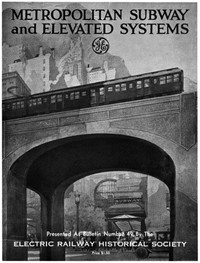
The bulletin opens not with a preface but with a dense statistical profile of the Boston Elevated Railway: 500 miles of line, 37 miles of subway and elevated track, 350 million annual passengers. The prose is clipped, data-driven, and devoid of narrative flourish. A reader encountering this for the first time should note that the text treats each city as a standalone case study, beginning with a block of numbers before describing routes and infrastructure. The opening establishes a pattern: expect a relentless catalog of figures, route lengths, and equipment specifications rather than historical context or human stories.
The Statistical Frame
The excerpts from the Boston section immediately immerse the reader in a world of precise measurement: “37 miles are subway and elevated tracks,” “92 square miles,” “350,000,000 per year.” The author—General Electric Company—presents these figures without interpretation, as if the numbers speak for themselves. This statistical frame recurs throughout the bulletin. In the New York section, one finds “1,013,678,831” passengers for the Interboro Lines in 1921, and a breakdown of power generating equipment totaling 195,000 kW at the 59th St. station. The reader should treat these numbers not as dry trivia but as the primary evidence the bulletin offers about the scale and engineering of early 20th-century rapid transit.
Route Descriptions as Structural Backbone
After the statistical opening, each city section shifts to a description of routes. Boston’s “four main routes” are listed with mileages: Forest Hills-Everett via tunnel (8.59 miles), via elevated (9.35 miles), Harvard-Andrew (5.56 miles), and so on. The New York section similarly enumerates lines—Manhattan Elevated, Queensboro Bridge Line, Webster Ave. Line—with track lengths and passenger counts. These route descriptions serve as the structural backbone of the bulletin, organizing the technical details that follow. A first-time reader can use these route lists as a map to navigate the subsequent discussions of power supply, substations, and rolling stock.
Technical Specificity and the Role of Equipment
The bulletin’s middle sections dive into engineering specifics: “625-volt direct current,” “third rail weighing … 75 lbs. per yard,” “GE-66 motors and Type M control.” The New York section notes that cars from 1902-4 are still in service, referred to as the “back-bone of the system.” This technical detail is not merely descriptive; it reveals the bulletin’s purpose as a record of existing equipment and practices. The reader should pay attention to the precise naming of components—synchronous converters, turbo-generators, motor car types—as these are the bulletin’s core content. The text assumes familiarity with electrical engineering terminology, so a first reading may require patience with the jargon.
Comparative Scope and the Philadelphia Example
The later excerpts introduce Philadelphia, offering a contrast to the earlier cities. The Philadelphia section is shorter and notes that “only the Frankford Elevated line has been built” from a 1912 plan, due to “legislative delays, and conditions due to the war.” This comparative scope—Boston’s mature system, New York’s vast network, Philadelphia’s delayed expansion—gives the bulletin a broader perspective. The reader should note that the text does not evaluate these differences; it simply presents facts. The Philadelphia section also mentions planned extensions, including a “four-track subway running north and south under Broad Street,” which hints at future developments not covered in the excerpts.
For a first reading, approach this bulletin as a technical reference rather than a narrative. The opening statistics set the tone; the route descriptions provide a framework; the equipment details are the substance. The Philadelphia section offers a useful counterpoint to the more extensive Boston and New York cases. Readers unfamiliar with electrical engineering may want to keep a glossary handy for terms like “synchronous converters” and “third rail.” The bulletin rewards careful attention to numbers and specifics, but does not offer interpretation or analysis.
That rainy afternoon, the Bulletin felt less like engineering data and more like a quiet conversation about how cities move—through tunnels, crowds, and time. The old GE survey’s meticulousness lingered, and I found myself wondering about the bones beneath those stations. Almost by accident, I reached for Some Mooted Questions in Reinforced Concrete Design American Society of Civil Engineers, Transactions, Paper No. 1169, Volume LXX, Dec. 1910 — A Closer Reading, and the rain seemed to settle deeper into the same questions.