The Problem of Manflight — Story, Setting & Ideas

  4   0
Means, James, 1853-1920 Project Gutenberg 2017
Airplanes; Aeronautics Readers of public-domain and historical texts
Project Gutenberg digital edition en

Edition facts

Words: 7,692
Reading time: 34 min
Text sections: 2
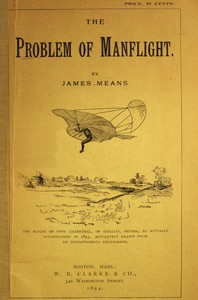
An 1894 pamphlet by James Means examines the debate between motorized and wind-powered flight, advocates for soaring machines, and provides detailed construction instructions for an automatic aeroplane model, citing Otto Lilienthal's experiments.
Share

James Means opens his 1894 pamphlet by framing aeronautics as the century's pressing mechanical problem, noting a "keen curiosity to know what the aerial machine of the future is likely to resemble." He positions himself between two camps: those like Hiram Maxim building motorized craft, and those like A. M. Wellington arguing that wind alone suffices. Means does not merely summarize; he enters the debate by quoting Wellington at length, who claims that motors are "predestined to certain failure" because they destroy the natural forces of flight. This editorial note examines how the catalog subjects—Airplanes and Aeronautics—only partially capture the pamphlet's actual content, which is less a history of flight than a polemical engineering proposal grounded in specific experiments and mechanical details.

A Debate Over Power Sources

The catalog subjects suggest a general work on airplanes, but the excerpts reveal a focused argument. Means presents two opposing views: motorized propulsion versus wind-powered soaring. He reproduces Wellington's assertion that gravity itself is "the best and smoothest of all conceivable means of propulsion" if the machine can use wind to "lift him uphill." Means does not endorse either side outright; instead, he uses the debate to introduce his own design for an automatic soaring machine. The pamphlet thus functions as a position paper within a specific technical controversy, not a comprehensive survey. Readers expecting a broad introduction to aeronautics will find a targeted intervention in a late-nineteenth-century engineering dispute.

Construction Details and Experimental Method

Means devotes substantial space to precise mechanical specifications. He describes a model with a "wooden backbone" of pine, a main aeroplane of "light tin plate" bent into a "flattened V" at about 170 degrees, and a steering aeroplane pivoted at cc. He specifies dimensions—eight inches wide and three feet long for the main plane—and materials. The design includes a pendulum mechanism with adjustable weights and rods, intended to make the machine "automatically steer itself into a horizontal or very slightly descending course." Means acknowledges unknowns: the proper weight for one component is "x, an unknown quantity" to be determined by experiment. This emphasis on trial and error, rather than theoretical certainty, aligns the pamphlet with practical engineering rather than pure science.

Sport, Recreation, and the Call for Experiments

Means concludes by urging public engagement through "regattas and large prizes," appealing to "the people's love of sport." He compares soaring to tobogganing, noting that "tobogganing on air is possible at all seasons." This rhetorical shift from technical description to promotional advocacy is striking. The catalog subjects do not hint at this sporting dimension. Means explicitly references Otto Lilienthal's flights as inspiration and suggests that once automatic steering is perfected, such flights will be "no more dangerous than football." The pamphlet thus serves as both a technical manual and a call to action, aiming to transfer the credit for solving flight from the twentieth century back to the nineteenth. This blend of engineering detail and popular appeal defines the work's unique character.

Readers should approach this pamphlet as a historical document of engineering advocacy rather than a finished treatise. Means writes from within a specific debate, using detailed construction plans and references to contemporaries like Lilienthal, Maxim, and Wellington. The catalog subjects of Airplanes and Aeronautics are accurate but incomplete; the work's core is a polemical proposal for wind-powered, automatically stabilized soaring machines. Pay attention to the interplay between technical specificity and rhetorical persuasion, and note how Means uses experimental uncertainty—the "unknown quantity"—to invite further investigation rather than claim final authority.

Related eBooks