About 33 minutes
Metropolitan Subway and Elevated Systems Bulletin 49 — Edition Insights
Civil Engineering
7,373 recorded words. 0 minutes difference from this book's estimate.
View Gutenberg source #54009
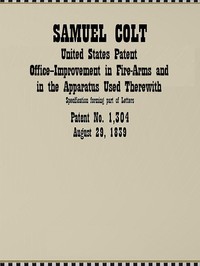
This digital edition of Improvement in Fire-Arms and in the Apparatus Used Therewith United States Patent Office Application — Story, Setting & Ideas is described by source-level measurements including 7,410 words, 33 min estimated reading time, and 1 detected text section.
The text analysis averages about 26.8 words per sentence, while the detected sections provide another way to judge how the source is divided.
Project Gutenberg metadata also associates the work with “Patents -- United States,” connecting these edition facts with the source record’s subject description.
Explore this collection
These alternatives are selected using recorded categories and estimated reading time.
About 33 minutes
Civil Engineering
7,373 recorded words. 0 minutes difference from this book's estimate.
View Gutenberg source #54009About 34 minutes
Civil Engineering
7,692 recorded words. 1 minutes difference from this book's estimate.
View Gutenberg source #56249About 39 minutes
Civil Engineering
8,799 recorded words. 6 minutes difference from this book's estimate.
View Gutenberg source #69016Search stored excerpts and compare books → Choose by your preferences →
Choices use stored catalog measurements. Estimates vary with reading speed. A shared category is a catalog label, not a claim that two books have the same argument or literary quality.
Search reads excerpt text stored with this catalog and links to its associated Gutenberg record. The connection is stored in the site database; this tool does not recheck that every excerpt is word-for-word identical to that external record. Excerpt search does not cover every chapter and does not verify historical publication dates.
Catalog snapshot checked: 2026-09-26. Coverage: 91 public books, 91 available source excerpts.
Calculated from edition completeness, EPUB availability, text structure and catalogue metadata. Not a user rating.
Total of 100 points, scaled to a 2.5-5.0 range. Editions with an empty description or a missing EPUB file are not scored.
Public-domain source text
The source text is kept in the dedicated reader, separate from this catalogue record and its commentary.
Samuel Colt's 1839 patent specification, Improvement in Fire-Arms and in the Apparatus Used Therewith, is a technical document that reveals the inventor's methodical approach to refining his revolving firearm design. Rather than a complete treatise on his invention, this patent focuses on specific modifications—such as a groove on the arbor to divert smoke from the lateral discharge, a conical aperture in the nipples to concentrate the percussion cap's flame, and a combined flask for simultaneously loading powder and balls into all chambers. The text is structured as a series of numbered claims, each describing a discrete mechanical improvement.
The specification opens with Colt declaring that he has made certain improvements to his previously patented fire-arms, and that he will now describe them. He explicitly refers readers to his earlier 1836 patent for the general construction, making this document a supplement rather than a standalone description. The language is precise and mechanical: Colt describes figures in the accompanying drawings, such as “a section through the lock and breech of my rifle or gun and two of the chambers of the revolving receiver.” He explains the function of each part—for example, the beveled edges of the chamber mouths are intended to reflect off ignited matter, preventing it from entering loaded chambers not aligned with the barrel. The patent concludes with a list of nine numbered claims, each beginning with “I claim,” which delineate the specific innovations Colt asserts as his own.
Following the main specification, the document includes a disclaimer dated August 29, 1839, in which Colt acknowledges that his original claim was “too broad, including that of which the said patentee was not the first inventor.” He states that he was an original inventor but had no knowledge of prior use when he applied. This disclaimer effectively narrows the patent's scope, a common practice in 19th-century patent law to avoid invalidation. The language is formal and legalistic, with Colt petitioning the Commissioner of Patents. This section provides insight into the iterative and contested nature of invention during the period, as well as the legal framework that inventors navigated.
The patent describes several specific mechanical features. One is a groove or channel on the arbor (the central axis of the revolving cylinder) that conducts off smoke from the lateral discharge, keeping the arbor clean. Another is the conical or funnel-shaped aperture through the nipples that receive percussion caps, designed to “freely admitting the fire from the percussion-cap and concentrating it as it enters the chamber.” Colt also details a key for attaching the barrel to the stock, with grooves and a tempering-screw to regulate its action as a wedge. The loading flask is described as having “chambered receptacles” that supply powder and balls to all chambers at once. These descriptions are accompanied by references to figures, though the text itself provides the functional rationale for each design choice.
Readers should approach this patent as a primary source in the history of firearms technology, noting how Colt balances specificity with legal strategy. The document's structure—a specification followed by a disclaimer—illustrates the interplay between invention and patent law. For those interested in mechanical design, the numbered claims offer a clear list of innovations, while the disclaimer reveals the practical challenges of claiming originality.
There’s something strangely comforting in old patents—how carefully someone thought about a small, practical problem, like smoke curling from a cylinder. That quiet attention to detail stayed with me long after. I felt it again, oddly enough, in the Third biennial report of the Oregon State Highway Commission — Context and Discussion, where roads and bridges get the same patient, hopeful consideration. Both left me thinking about hands at work, making things a little better.
Create a short personal record of your experience with this book.