About 47 minutes
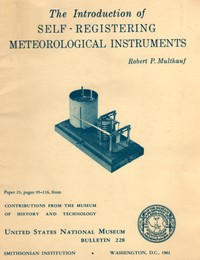
The Introduction of Self-Registering Meteorological Instruments — Reading Notes
Mechanical Engineering
10,722 recorded words. 0 minutes difference from this book's estimate.
View Gutenberg source #32482
This digital edition of Wireless Possibilities — A Closer Reading is described by source-level measurements including 10,738 words, 47 min estimated reading time, and 2 detected text sections.
The text analysis averages about 26.8 words per sentence, while the detected sections provide another way to judge how the source is divided.
Project Gutenberg metadata also associates the work with “Radio,” connecting these edition facts with the source record’s subject description.
Explore this collection
These alternatives are selected using recorded categories and estimated reading time.
About 47 minutes
Mechanical Engineering
10,722 recorded words. 0 minutes difference from this book's estimate.
View Gutenberg source #32482About 55 minutes
Mechanical Engineering
12,600 recorded words. 8 minutes difference from this book's estimate.
View Gutenberg source #48360About 58 minutes
Mechanical Engineering
13,278 recorded words. 11 minutes difference from this book's estimate.
View Gutenberg source #29934Search stored excerpts and compare books → Choose by your preferences →
Choices use stored catalog measurements. Estimates vary with reading speed. A shared category is a catalog label, not a claim that two books have the same argument or literary quality.
Search reads excerpt text stored with this catalog and links to its associated Gutenberg record. The connection is stored in the site database; this tool does not recheck that every excerpt is word-for-word identical to that external record. Excerpt search does not cover every chapter and does not verify historical publication dates.
Catalog snapshot checked: 2026-09-26. Coverage: 91 public books, 91 available source excerpts.
Calculated from edition completeness, EPUB availability, text structure and catalogue metadata. Not a user rating.
Total of 100 points, scaled to a 2.5-5.0 range. Editions with an empty description or a missing EPUB file are not scored.
Public-domain source text
The source text is kept in the dedicated reader, separate from this catalogue record and its commentary.
A. M. Low opens Wireless Possibilities not with a circuit diagram but with a meditation on the nature of invention itself. He calls it “the science and art of continuity of thought,” a phrase that sets the tone for a book as concerned with the psychology of progress as with the physics of radio. Low’s voice is conversational, even wry—he remarks that invention is “a work of love” and “never paid”—and he frequently interrupts technical passages with aphorisms or self-deprecating asides. The result is a text that oscillates between earnest prediction and skeptical humor, as when he suggests that if we are not stirred to do our best, “we are indeed a nation of shopkeepers.”
Low devotes the opening chapter to defining invention as a habit of mind rather than a mechanical skill. He argues that training oneself to “forget the smell of the beefsteak when hungry” is a way to sustain a sequence of ideas—a homely metaphor for intellectual discipline. The prose here is aphoristic: “If not one day is spent without something learnt, surely we have achieved the greatest object of work.” Low also warns against complacency, noting that “before many centuries have passed we shall be held in almost universal contempt.” This section establishes a rhetorical pattern: Low moves from a concrete, often domestic image to a broader claim about progress, then undercuts it with a wry or deflating remark. The effect is to keep the reader off balance, never quite sure whether the next sentence will be a technical insight or a philosophical jab.
The chapter on sound and wireless transmission shifts abruptly into a discussion of television, which Low calls “Radio Television.” He explains the selenium cell’s property of varying resistance with light, then describes a system that modulates a current to operate “a kind of electrically operated venetian blind.” The explanation is deliberately simplified: “It takes a long time, is rather patched, and is liable to interference; but the whole process is perfectly simple.” Low then pivots to the physiology of vision, using the example of a whirled cigarette that appears as “a ring of fire” to illustrate retinal persistence—the principle behind cinema. His tone becomes almost playful: “The eye is a very defective piece of mechanism.” Throughout, Low’s language remains concrete and analogy-driven, avoiding jargon in favor of everyday objects like top hats, arc lamps, and venetian blinds.
Low’s predictions for wireless are both ambitious and hedged. He imagines a future where business can be conducted from home without “having his spats washed every week in order to maintain his financial reputation.” Yet he also acknowledges the gap between possibility and practice: transmitting a two-inch-square picture by the spot method would take about fifteen minutes at modern speeds. To achieve television, he calculates, the time must be reduced to “4/5 of a second altogether.” Low offers a workaround—decreasing the number of spots—but admits that even then, the apparatus could only show whether a New York office was lit, not what the light source was. This section exemplifies Low’s method: he sketches a bold vision, then immediately qualifies it with practical constraints, often with a dry aside. The reader is left with a sense of possibility tempered by the author’s own skepticism.
Low’s book rewards a reader willing to follow his digressions. The technical explanations are often sketchy—he admits as much—but the value lies in the interplay between enthusiasm and caution. Pay attention to the asides: they reveal a mind that sees invention as a moral as well as a mechanical endeavor. The diagrams mentioned in the preface are not included in this edition, so the text alone must carry the argument. Read for the voice, not just the facts.
Sometimes invention begins not in the ether, but in the patience of breath and flame. Low’s quiet awe before the invisible feels akin to the glass-blower’s devotion to the tangible—both trust what cannot be forced. I recall A handbook of laboratory glass-blowing — Themes and Context, whose gentle, deliberate pages share that same unhurried faith in careful hands and open minds.
Create a short personal record of your experience with this book.